AI initiatives don’t fail because of technology - they fail because of weak decisions upstream.
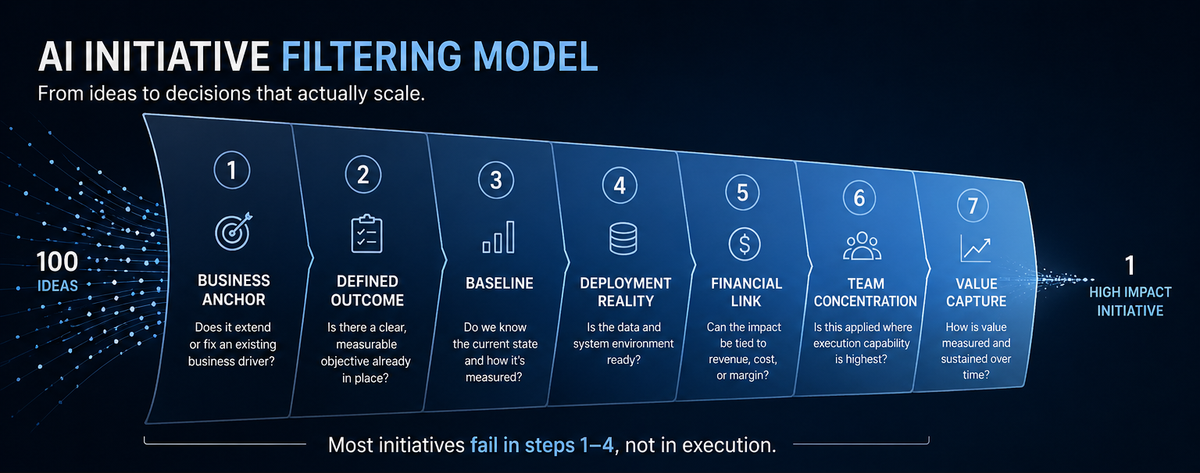
Today, the constraint is not access to models or tools. It’s the ability to make disciplined decisions about where AI actually belongs in the business and where it doesn’t.
If you look at how initiatives evolve internally, the pattern is consistent. Ideas start broad, often inspired by what others are doing. They gain momentum because they sound promising, not because they are grounded. Teams get involved, pilots are launched, and somewhere along the way the connection to real business impact becomes blurred. Not because people are incompetent, but because the filtering mechanism is missing.
That’s the core issue. Not execution, but selection.
The way to fix this is not to add more governance or more process layers. It’s to change the order in which decisions are made.
Start from the business as it exists today, not from what AI could theoretically enable. The first question is not "What can we build?" but "What are we trying to extend or fix?"
Revenue streams, cost structures, operational bottlenecks - these are the only valid entry points. If an initiative does not clearly anchor itself in one of these, it will remain peripheral, regardless of how advanced the technology is.
Once that anchor is clear, the next step is to remove ambiguity around outcomes. Vague goals like “improving efficiency” or “enhancing experience” are not operational. Strong initiatives are tied to outcomes that already matter inside the organization. They improve something that is already measured, already discussed, already owned. This is what creates alignment without forcing it.
From there, the conversation becomes more concrete. What is the current state, and how is it measured today? Without a baseline, every result looks good on paper. With a baseline, you immediately see whether the initiative is meaningful or marginal. This is where many efforts lose momentum, because the gap between narrative and reality becomes visible.
The next layer is less visible but often decisive. Even when the business case is solid, the organization itself may not be ready to absorb the change. Data is fragmented, ownership is unclear, and systems don’t talk to each other. In these situations, the limiting factor is not the model but the environment around it. Ignoring this leads to technically successful pilots that cannot be scaled.
That is why financial alignment is not a late-stage validation but a central filter. If the initiative cannot be directly linked to revenue, cost, or margin, it will struggle to compete for attention and resources. Not because it has no value, but because its value is not legible in the language the business uses to make decisions.
At this point, most organizations try to scale horizontally, pushing initiatives across multiple teams. In practice, this dilutes impact. The better approach is selective concentration. Focus on the teams where both the need and the execution capability are high. AI does not compensate for weak execution. It amplifies what is already there.
What happens after deployment is where the real differentiation starts. Many initiatives stop at “it works.” In reality, that’s the beginning. Value is only realized when the solution becomes part of how the business operates day to day. That requires iteration, ownership, and a clear plan for how outcomes will be captured over time. Without that, even good initiatives remain isolated improvements.
Seen this way, AI is not a layer you add on top of the business. It’s a mechanism that forces sharper decisions inside it.
The organizations that will move ahead are not the ones running the most experiments. They are the ones that are more selective, more deliberate, and more consistent in how they evaluate opportunities. They treat AI less as a space to explore and more as a lever that must justify its place.
That shift, from exploration to discipline, is subtle, but it changes everything.